

Foundation models made for the clinic
Trained on hundreds of millions of H&E image tiles and fine-tuned to capture tissue biology rather than scanner or staining differences, our foundation models give consistent results from one laboratory to the next.
From compact 86-million-parameter models to billion-parameter ones, our foundation models form the basis of Waiv’s AI tests.
Our fine-tuning makes models care less about the scanner and more about the tissue.
Pathology foundation models have grown to billions of parameters. Yet they still encode where a slide was scanned and stained, not just what the tissue shows. So a model that tops a benchmark can give a different answer in a different lab. We build models that don’t.
Our fine-tuning teaches models to ignore scanner and stain, and focus on biology.
We distil billion-parameter knowledge into models small enough to run anywhere.
Every model is benchmarked publicly, released to the community, and used in our own validated tests.
Four years of foundation models, each one a step further
Five open models, each solving a real deployment problem: scale, open data, speed, then robustness.
Distilled from H-Optimus-0 without its projection heads, then fine-tuned, it beats its 13× larger teacher on robustness and slide-level performance.
Our fine-tuning raised Phikon-v2’s robustness index from 0.47 to 0.81, with better scores on every downstream benchmark.
Also the best average score across 63 slide-level tasks on Patho-Bench, from mutation prediction to survival.
The most robust model on the PLISM scanner and staining benchmark at publication (MICCAI 2025), at under 8% of its teacher’s size.
Trained only on publicly available data across 30+ cancer sites, it performs on par with models trained on proprietary data.
First open pathology foundation model, trained on 43M tiles from 6,000 TCGA slides across 16 cancer types. It powered the winning solution of the UBC-OCEAN Kaggle challenge.
Same tissue, same answer, any scanner
Mascaret is the most robust publicly available pathology foundation model on PathoROB, the benchmark that measures sensitivity to hospital, scanner and staining differences.
Publicly available models only, except AquaViT, which is an internal model similar to H0-mini but fully trained and owned by Waiv. It followed the distillation recipe of H0-mini, but without access to the projection heads typically needed for distillation. It was then fine-tuned like Mascaret and Phaet.
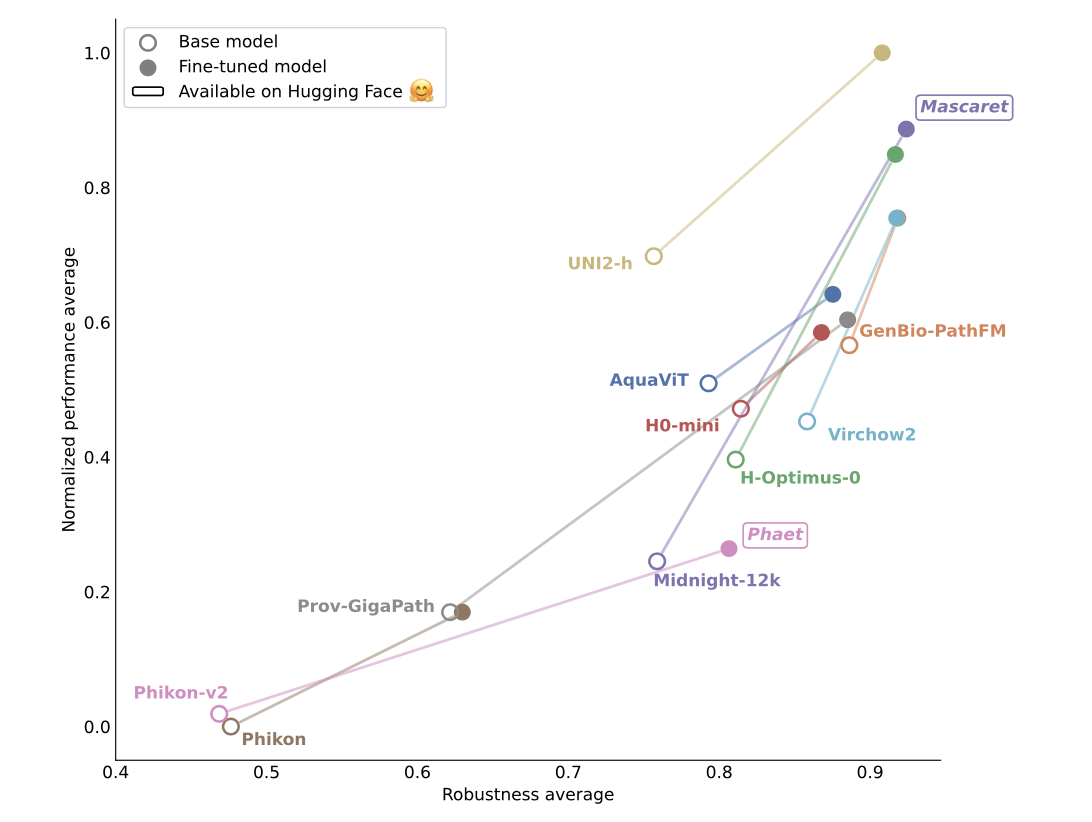
Our fine-tuning made all ten foundation models we tested more robust (+23% on average) and better on downstream tasks (+43%), with no trade-off.
Same tissue, five hospitals, three scanners. Before fine-tuning, Phikon-v2 groups tiles by where they were scanned; after, Phaet groups them by tumour versus normal tissue, for hospitals it never saw in training.

AquaViT extracts features about 10x faster than its 1.1B-parameter teacher, while staying competitive on gene-expression prediction.
Our foundation models are the starting point for Waiv’s AI tests. The published validations of RlapsRisk BC (Nature Communications, 2025) and MSIntuit CRC (Nature Communications, 2023) were built on Phikon and an earlier, colorectal-specific version of it, and the latest versions of our products use our fine-tuned models. Most recently, BRCAura, which predicts germline BRCA1/2 mutations from routine H&E slides, was built on AquaViT and validated on 1,025 patients across six centres, with consistent performance across staining protocols and scanners (npj Precision Oncology, 2026).
Build your next biomarker on models that hold up
From target discovery to companion diagnostics, we partner with pharma and biotech teams to find biomarkers in routine H&E slides, enrich and stratify trials, and turn those signals into tests that hold up in every lab.